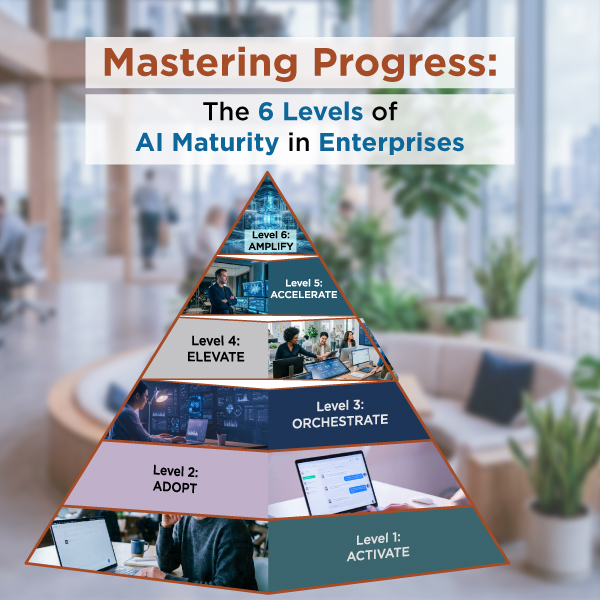
Artificial Intelligence (AI) has advanced quickly in businesses, but most organizations still struggle to move from basic trials to fully integrated, value-generating systems. The six levels of AI maturity help explain this journey. At the first level, AI is just a search bar, acting as a simple tool that raises awareness but adds little real value. As companies progress, AI becomes more like an assistant, helping people create content or finish tasks, but it is still not part of core processes or decision-making. Real change happens when AI acts as a teammate: it keeps context, feeds outputs into actual work, and boosts productivity. Still, at this stage, AI’s benefits usually stay limited to individuals or small teams, and sharing best practices is often unstructured.
Reaching Level 4 is a major milestone. Here, AI becomes the backbone of the organization, fully built into workflows, project cycles, and review processes. Shared playbooks and standard outputs start to appear, but getting to this point takes more than training. It needs a careful redesign of systems, workflows, and expectations, led by committed leaders. At Level 5, AI operates on autopilot, automating tasks and moving people into roles focused on supervision and exception handling. This brings more efficiency, speed, and predictability, but also increases the need for strong governance and risk management. At Level 6, AI becomes the driving force of the organization, learning from use, building on knowledge, and pushing innovation to set new industry standards.
Even with big investments in AI tools and training, most companies get stuck at Levels 2 or 3. The main problem is not the technology or lack of understanding, but the failure to make AI a system-wide capability. Many businesses see AI as just a skill gap to fill, instead of a change that needs to be managed across the whole system. Without integrating AI into workflows, aligning leadership, and setting common practices, AI stays separate and does not change how work gets done. Moving up the maturity levels takes intentional behavior changes early on and careful system design later. The key to success is seeing AI not just as new technology, but as a new way of running the business.
This is where VMI Global makes a real difference. VMI Global sees AI as a core part of operations that should be developed, measured, and scaled, not just a tool to use. Using behavioral measurement in real-world situations, VMI Global provides organizations with clear, data-driven assessments of their AI maturity. Their approach helps companies move intentionally between maturity levels, from adding AI to daily work to building advanced governance and automated processes. VMI Global is dedicated to finding and solving problems like skill gaps, process issues, and resistance to change. This helps businesses move from trying out AI to building a strong, AI-driven system. Their method ensures that adopting AI leads to real, lasting results that set new standards for enterprise performance.