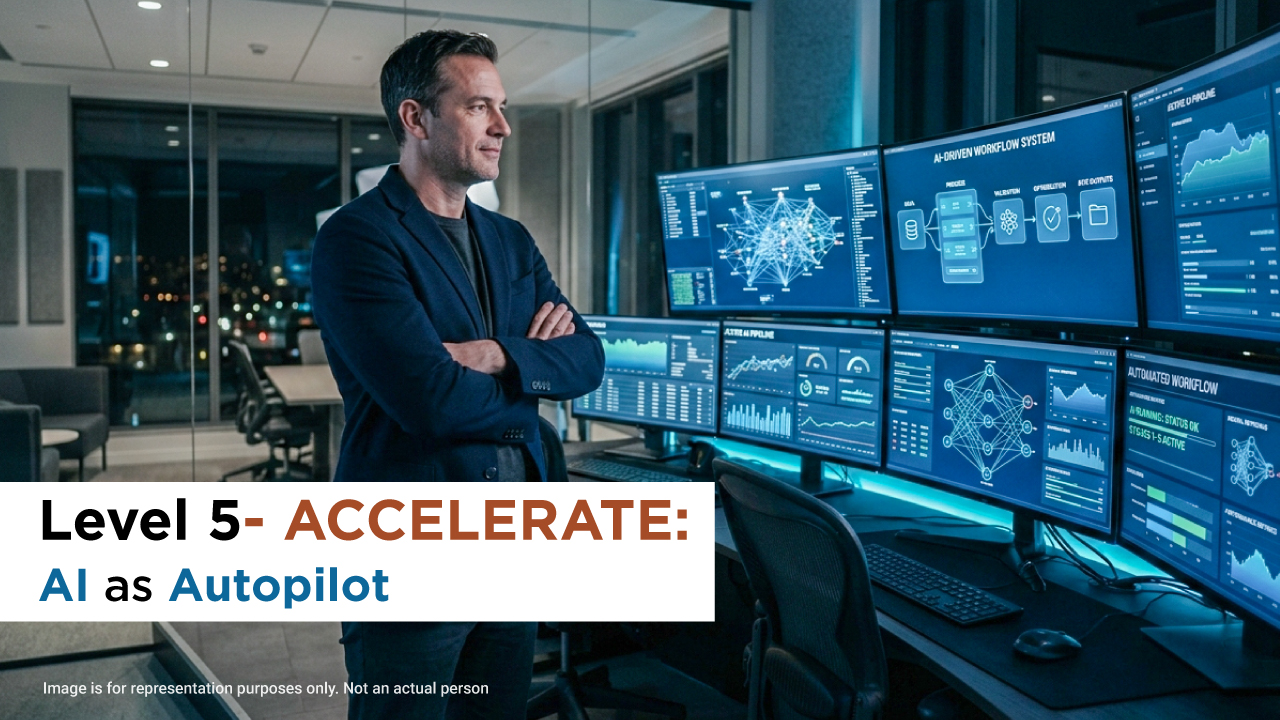
When Workflows Run Themselves & Humans Shift to Oversight
At this stage, the role of AI changes completely.
It is no longer embedded just to support execution. It begins to drive execution.
This is Level 5.
AI moves from being part of the workflow to running the workflow. Tasks are no longer manually executed step by step. They are orchestrated through systems. Multiple AI agents handle sequences of work, passing outputs from one stage to the next.
Human involvement does not disappear. It evolves.
People stop doing the work. They start supervising it.
What Level 5 Looks Like in Reality
In Level 5 environments, workflows are automated end-to-end.
The marketing campaign is not handcrafted. AI systems produce strategy inputs, generate content, optimize messaging, and prepare reports. Scattered tools are not used to manage a product cycle. AI organizes documentation, monitors progress, and identifies risks.
Systems run workflows.
Tasks are activated automatically. There is no constant human input to outputs. Processes become predictable.
Teams waste no time on repetitive tasks. They are interested in measuring results, handling exceptions, and enhancing the system.
This generates an alternate operating model.
Execution becomes continuous.
The Shift from Execution to Supervision
Level 5 introduces a fundamental shift in human roles.
In earlier stages, employees were responsible for producing outputs. At this stage, they are responsible for ensuring quality, accuracy, and alignment.
Work is no longer about doing. It is about overseeing.
This requires a different skill set.
Employees should know how the systems work, where they may go wrong, and when to step in. They should be able to analyze outputs rather than develop them. The process of making decisions overshadows the act.
Those organizations that fail to prepare for it struggle.
Since it is no longer a question of productivity, it is a question of control.
Why This Level Unlocks True Efficiency
Level 5 is where organizations begin to see exponential gains.
Automation reduces manual effort. Processes run faster. Output volume increases without proportional increases in headcount.
But the real advantage is predictability. Variation is reduced when a system-driven workflow is in place. Mistakes become more easily spotted. Performance becomes measurable.
This brings about operational stability.
Organizations do not have to grow in complexity. The teams can deal with more work without overworking themselves. Leaders can get a real-time view of how systems are functioning.
AI ceases to be a productivity aid and transforms into an efficiency engine.
The Risks of Autopilot
This level also introduces new risks.
When systems run autonomously, errors can scale quickly. A flawed input can affect an entire workflow. A misaligned objective can produce consistent but incorrect outputs.
Without proper governance, automation becomes dangerous.
Organizations must build:
Control mechanisms to monitor outputs
Intervention points where humans can step in
Feedback loops to improve system performance
Trust in AI must be balanced with oversight.
Level 5 is not about removing humans. It is about redefining their role.
What Is Still Missing
Even with advanced automation, key elements are still evolving:
Learning Systems: Workflows do not yet improve themselves automatically
Adaptive Intelligence: Systems require manual updates and adjustments
Strategic Integration: AI drives execution, but not long-term innovation
This is why Level 5 is powerful, but not complete.
The system runs efficiently. It does not yet evolve independently.
The Role of VMI Global
At Level 5, the challenge shifts again.
It is no longer about building systems. It is about managing them.
VMI Global assists companies in transitioning from structured workflows to automated ecosystems. Identifying processes that can be easily automated and those that require further standardization is the first step. Not every workflow is to be automated right away. Precision matters.
As soon as it is identified, VMI Global assists in developing multi-agent systems capable of performing tasks sequentially. Such systems are business-oriented and have business objectives in mind, so automation does not lose its way.
The focus on governance emerges.
VMI Global establishes control mechanisms that determine how systems are tracked, when human control is needed, and how risks are managed. This will make automation dependable and responsible.
The system also incorporates measurement.
Organizations can see results in terms of performance indicators, error rates, and efficiency gains. This enables continuous optimization. Systems are not static. They are perfected with time with actual data.
VMI Global also trains teams for role changes. Staff are trained to monitor systems, interpret outputs, and address exceptions. This will enable human capabilities to develop alongside technological capabilities.
The goal is evident. Switch execution to orchestration.
What Comes Next
Level 5 demonstrates that AI can work.
But running work is not the final stage.
The next level is where systems begin to learn, adapt, and improve on their own. Where knowledge compounds. Where capability grows without direct input.
That is where AI becomes the engine.
Key Insights
| Key Insights | Explanation |
|---|---|
| AI shifts from supporting workflows to running them | At this stage, AI automates end-to-end processes through coordinated systems. |
| Human roles evolve from execution to supervision | Employees focus on oversight, decision-making, and exception handling rather than task completion. |
| Automation creates exponential efficiency & predictability | Work scales without proportional increases in effort, and outputs become more consistent. |
| Governance becomes critical in automated systems | Without control mechanisms, errors can scale quickly across workflows. |
| True maturity requires balancing automation with oversight | Organizations must combine system efficiency with human judgment to maintain quality and alignment. |
Frequently Asked Questions (FAQs)
It means workflows are automated and executed by AI systems with minimal human intervention. Tasks are triggered, processed, and completed through coordinated systems. Humans primarily supervise and manage exceptions.
At Level 4, AI is embedded into workflows, while at Level 5, it runs those workflows. The focus shifts from integration to automation. This reduces manual effort and increases efficiency at scale.
Errors can scale quickly if systems are not properly monitored. Misaligned inputs or objectives can lead to consistent but incorrect outputs. This makes governance and oversight essential.
They need to understand system behavior, monitor outputs, and handle exceptions. Decision-making and analytical skills become more important than execution. This represents a shift from doing work to managing it.
They must standardize workflows before automating them and build strong governance frameworks. Continuous monitoring and optimization are essential. This ensures automation remains aligned with business goals.