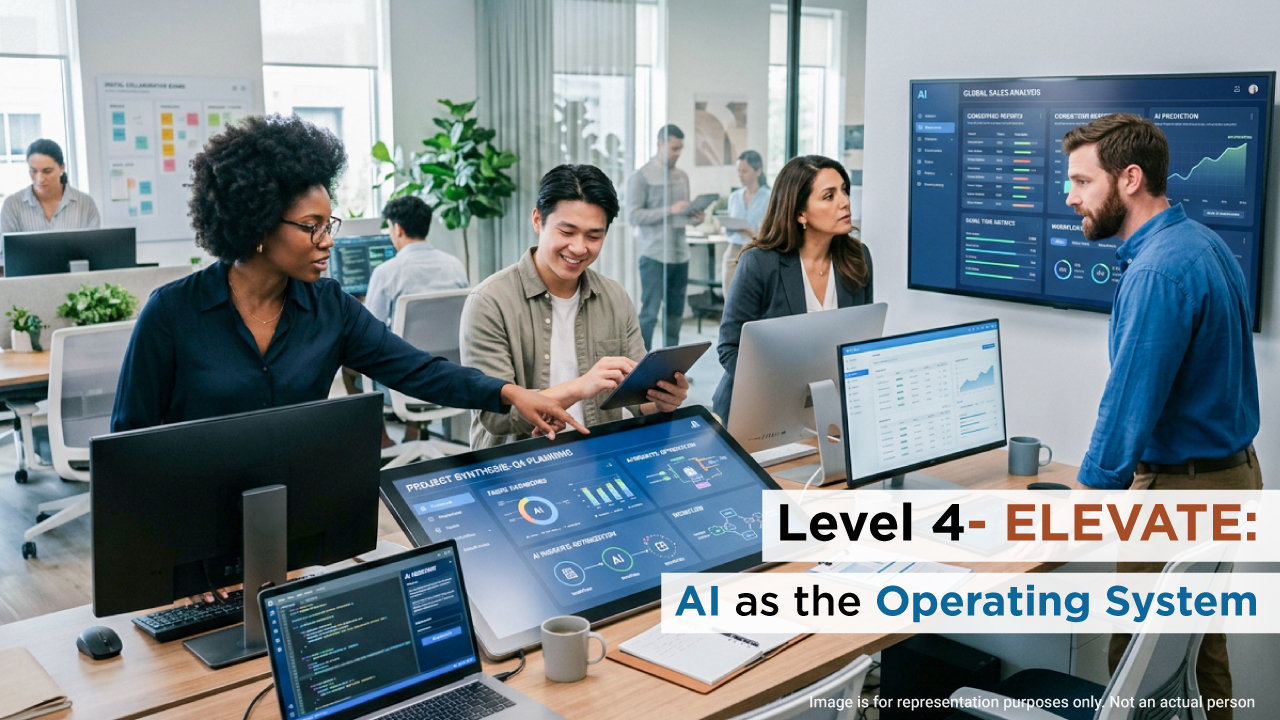
When AI Moves from Individual Use to Team-Level Execution
At this stage, the shift is no longer subtle.
AI is not just being used. It is not just assisting. It is not even limited to individuals working smarter. It becomes part of how teams operate.
This is Level 4.
AI becomes the operating system of work. It is embedded into workflows, integrated into delivery, and aligned across teams. It is no longer optional. It is expected.
For the first time, AI begins to scale.
What Level 4 Looks Like in Reality
At Level 4 , the AI is no longer possessed by individuals. It is programmed into the system.
Personal workflow is not applicable in teams. They work using common playbooks. The ways of using AI in particular tasks, roles, and outputs are defined. The process remains the same whether it is preparing reports, analyzing data, or making presentations.
The workflows are restructured to incorporate AI at every step.
There are AI-based inputs in planning cycles. Structured prompts and tools assist in the execution processes. AI is applied in review systems to measure quality and consistency. Teams work together with an understanding of AI's contribution to delivery.
This creates alignment.
Outputs become predictable. Quality becomes repeatable. Teamwork is enhanced.
AI ceases to be a support layer. It is part of the operating fabric.
The Shift from Individuals to Systems
Level 4 is a radical change.
Value in the earlier stages was people-driven. Systems lead to value at this stage.
It is not about who can use AI well, but about the use of AI within the organization.
This eliminates reliance on individual ability.
There is no need for new employees to learn how to use AI. They are entered into well-organized processes. Processes do not have to be reinvented by teams. They abide by systems. Leaders do not use assumptions. They are clear in their operation.
AI becomes institutionalized.
Why This Level Changes Everything
Level 4 is the turning point for real enterprise impact.
For the first time, AI influences how work is delivered at scale. It is no longer limited to pockets of excellence. It becomes a shared capability.
This creates three major outcomes:
Consistency: Outputs across teams follow the same standards
Efficiency: Work is completed faster with less variation
Scalability: Processes can be replicated across functions and geographies
Organizations begin to see measurable value.
AI is no longer an experiment. It is infrastructure.
What It Takes to Reach Level 4
Reaching this level is not a natural progression. It requires intentional design.
Organizations must move beyond training and focus on system-building.
This includes:
Defining how AI fits into each workflow
Creating shared playbooks for different roles and functions
Standardizing outputs and quality benchmarks
Aligning leadership expectations across teams
This is where many organizations struggle.
They are trying to increase AI usage without reinventing how work is done. This leaves them in a state of organizational inconsistency and individual success.
Level 4 involves a change of mindset.
Employees do not use AI. It is something the organization runs on.
What Is Still Missing
Even at this stage, some elements must be strengthened:
Governance: Clear structures to manage AI usage, risk, and quality
Measurement: Systems to track impact across workflows and teams
Optimization: Continuous improvement of playbooks and processes
Without these, organizations may reach Level 4 but struggle to sustain it.
The system exists, but it is not yet self-improving.
The Role of VMI Global
This is where VMI Global enables the transition from structure to scale.
At Level 4, the challenge is not adoption or capability. It is design.
VMI Global collaborates with companies to incorporate AI into their operating models. It will start by mapping how work is currently done across teams, and where AI can be incorporated to create the greatest impact. This would ensure AI is not overlaid on workflows but rather embedded in them.
System creation is the second step.
VMI Global also creates designed playbooks outlining AI utilization in roles, tasks, and deliverables. These playbooks are not generic. They are designed for the organization's context, making them relevant and usable. This provides uniformity in teams and flexibility where necessary.
Integration of workflow is then operationalized. AI is included in the planning, implementation, and analysis stages. Teams work under common standards, and outcomes meet established quality standards. Leaders can see the contribution of AI to performance, which helps them to make better decisions.
Governance and measurement frameworks are also presented at VMI Global. This will make the use of AI regulated, monitored, and constantly enhanced. AI is not only being used in organizations. They are treating it as a competency.
The goal is evident. Make AI the system of the enterprise.
What Comes Next
Level 4 proves that AI can scale.
But scaling is not the end.
The next level is where systems begin to run with minimal human intervention. Workflows become automated. AI moves from supporting execution to driving it.
That is where efficiency becomes exponential.
Key Insights
| Insight | Explanation |
|---|---|
| AI becomes a system, not a tool | At this stage, AI is embedded into workflows and becomes part of how teams operate. |
| Standardization enables scalability | Shared playbooks and processes ensure consistent and repeatable outcomes across teams. |
| Organizational alignment replaces individual dependency | Success no longer depends on high performers but on structured systems. |
| Workflow redesign is essential for maturity | Scaling AI requires rethinking how work is done, not just increasing usage. |
| Governance and measurement become critical | Managing AI as a capability requires oversight, tracking, and continuous optimization. |
Frequently Asked Questions (FAQs)
It means AI is embedded into workflows, processes, and team operations rather than used individually. It supports planning, execution, and review across functions. This creates consistency and scalability in how work is delivered.
At Level 3, AI improves individual performance, while at Level 4, it is standardized across teams. Workflows are redesigned to include AI, making it a shared capability. This shifts value from individuals to systems.
Because AI begins to deliver measurable impact at scale. Organizations achieve consistency, efficiency, and repeatability in outputs. It marks the transition from experimentation to operational integration.
They struggle with redesigning workflows, aligning teams, and creating shared practices. Many focus on increasing usage rather than building systems. This prevents AI from scaling effectively.
They must standardize AI usage, create playbooks, and integrate AI into core workflows. Leadership alignment and governance are essential. This ensures AI becomes a structured and scalable capability.