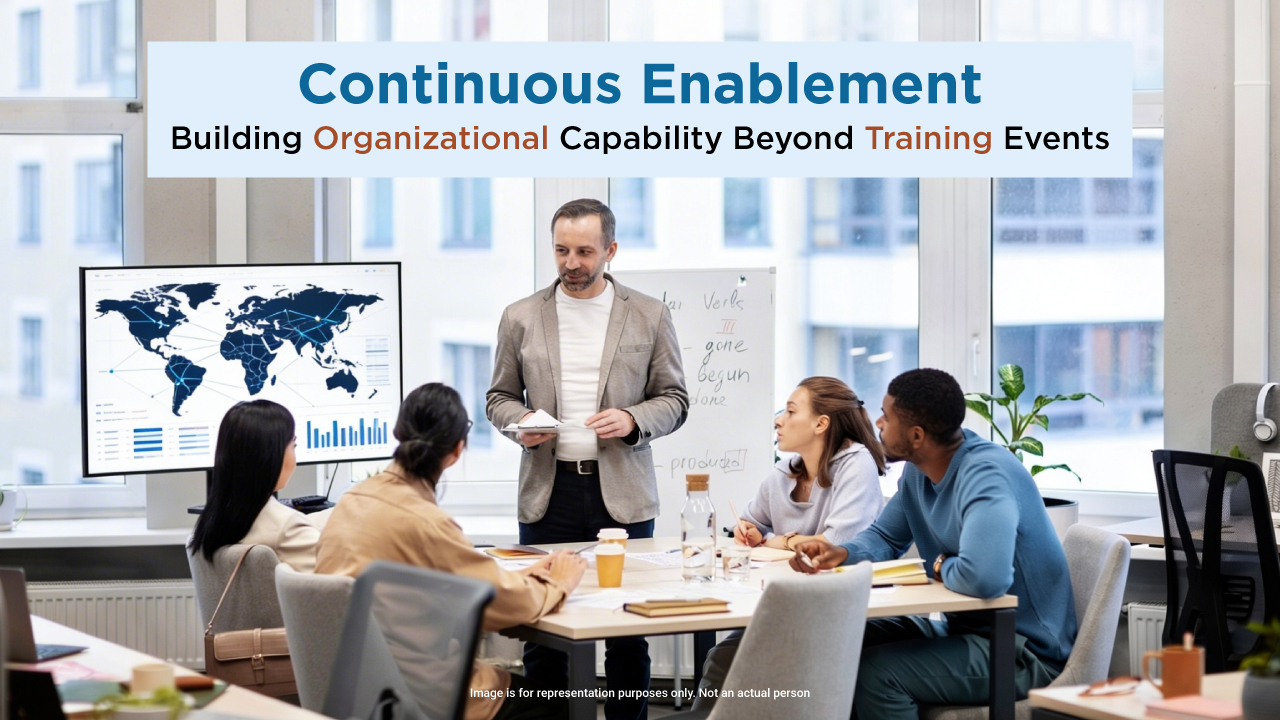
The meeting room was packed, the presentations were clean, and the training schedule was impressive. People listened, nodded, made notes, and even got inspired over the course of three days. Feedback scores were high. Leadership felt reassured. Something had been done.
But after three months, nothing much had altered.
The same questions were found on reviews. These inefficiencies also hindered decision-making. These same holes would manifest themselves under pressure. It was not a problem of intent, effort, or even of investment. The issue was that it was believed that training alone makes ability.
Training vs. Enablement: Why Sustainable Organizational Growth Demands More Than One-Off Events
Organizations often confuse exposure with mastery. A workshop is a way of introducing ideas; it does not instill behavior. A certification confirms what one has learned, but it does not ensure practice. Knowledge that is not relevant to everyday work gradually wanes, not because people lack interest, but because the system does not encourage change.
Capability fades fast in fast-paced settings. Markets transform, tools vary, and customer demands alter, and what was learned half a year ago might already be obsolete. Even the most carefully designed training, without reinforcement, application in context, and real-time support, becomes a memory rather than a muscle.
The Importance of Ongoing Enablement After Training
It is manifested in the managerial coaching that takes place after the classroom. It is represented in playbooks that change based on real-world feedback. It coexists in common language, tools of trade, and decision-making structures that teams use on a daily basis. Enablement does not refer to the impartation of content; it refers to molding behavior when needed.
Organizations that drive real change don’t ask, “Did people attend?” Instead, they ask, “Can people execute?” The focus shifts from participation to capability, ensuring that new patterns lead to real, actionable results.
They observe a wide range of key indicators: Are faster, more agile teams adapting even more effectively and efficiently to change? Are mistakes and errors being identified and addressed much earlier in the process, before they escalate or cause bigger issues? Are decisions becoming more confident, data-driven, and predictable, with greater clarity and consistency for everyone involved? True enablement ultimately shows up in measurable outcomes, and not just certificates, resulting in shorter feedback cycles, richer, more productive communication, and a reduced reliance on last-minute heroics or extraordinary effort for success. These positive changes signal that the organization is truly capable of sustaining growth and driving continuous improvement across all levels.
Leadership Mindset Shift: Driving Continuous Improvement in Organizations
Leaders need to shift their sponsoring programs to environmental building. The process of enablement requires time since the fruits of patience do not bring immediate rewards. It involves coordination since actions that are divided weaken. Above all, it must be owned, not necessarily by HR, but by business leaders who perceive capability as a strategic resource rather than a support activity.
Once the process of enablement is continuous, learning ceases to be an object to which people go, and becomes an object to which people work. Knowledge is used, experimented with, improved, and reused. Teams become not only more intelligent, but also stronger.
The winning organizations do not have the most training. They are the ones who facilitate indefatigably.
VMI Global’s Role in Continuous Organizational Enablement & Capability Building
That is precisely the point of intersection that VMI Global works on. Instead of creating isolated learning experiences, VMI Global helps organizations build capability ecosystems that meet real business objectives. Its strategy aims to integrate learning into work processes, leadership cycles, and implementation systems.
VMI Global bridges the gap between strategy, skills, tools, and accountability, enabling deliverables to not die once delivered. The programs are designed to evolve, adapt, and scale to support teams even after the initial engagement. VMI Global works closely with client organizations to deeply understand their unique challenges and goals, ensuring that every solution is customized, practical, and sustainable in the long run. By leveraging cutting-edge analytics, ongoing feedback mechanisms, and industry best practices, VMI Global empowers teams to embed learning into daily routines and drive behavioral change at every level.
Key Insights
| Insight | Explanation |
|---|---|
| Training alone does not build capability | One-time training events may create awareness, but without reinforcement and application, they fail to drive lasting behavioral change. |
| Enablement transforms knowledge into action | Continuous enablement embeds learning into daily workflows, ensuring skills are practiced, refined, and applied in real time. |
| Sustainable growth requires system-based learning | Organizations must build structured enablement ecosystems rather than rely on individual effort or isolated learning initiatives. |
| Leadership ownership is critical for enablement success | Enablement must be driven by business leaders who view capability building as a strategic priority, not just an HR function. |
| Real enablement is measured through performance outcomes | True success is reflected in improved decision-making, faster execution, and reduced errors, rather than attendance or completion metrics. |
Frequently Asked Questions (FAQs)
Continuous enablement is an ongoing process that integrates learning into daily work through coaching, tools, and feedback. Unlike one-time training events, it focuses on sustained behavior change and real-world application of skills.
Training programs typically provide knowledge but lack reinforcement, follow-up, and practical application. Without continuous support, employees tend to forget or fail to apply what they have learned.
Organizations can embed learning into workflows, provide ongoing coaching, and create feedback loops. They should also align enablement with business goals and ensure access to tools and updated playbooks.
Leaders must actively support and model continuous learning, treating capability building as a strategic priority. Their involvement ensures alignment, accountability, and long-term sustainability of enablement efforts.
VMI Global helps organizations build integrated capability ecosystems that connect strategy, skills, and execution. Through customized solutions and ongoing support, we ensure that learning leads to measurable business outcomes.