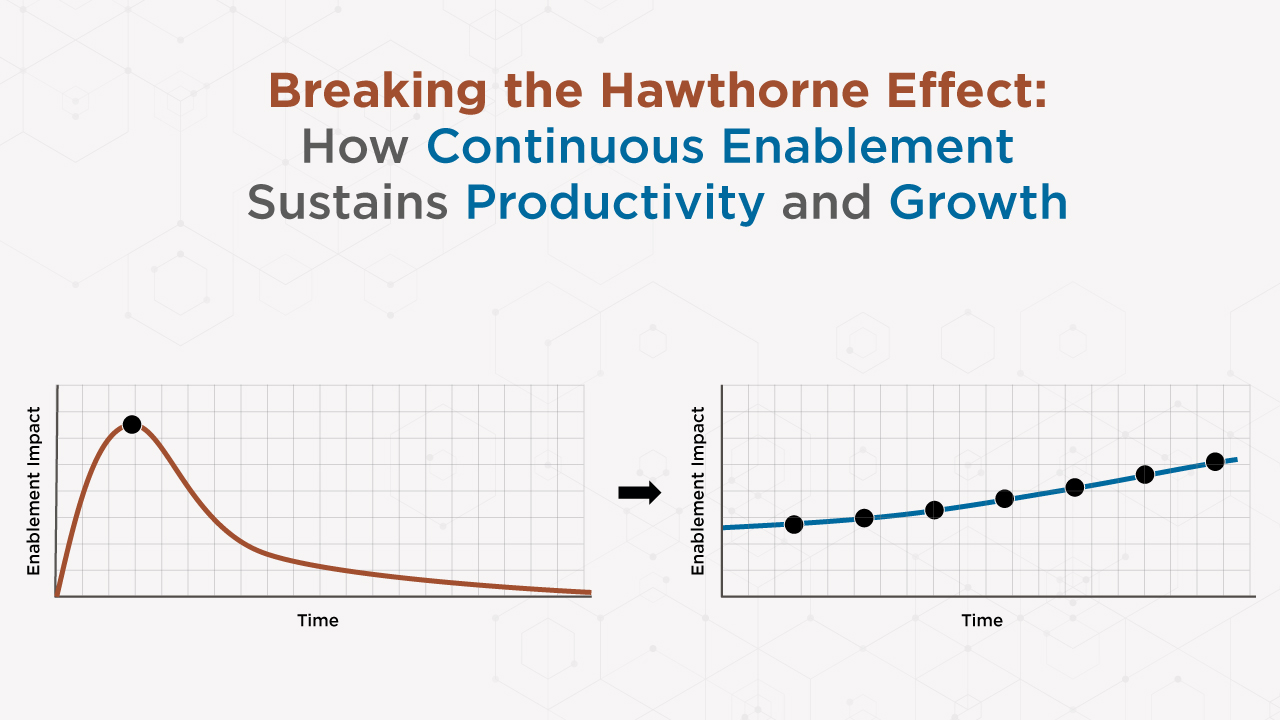
Many businesses struggle to sustain the benefits of learning and development. Training and workshops can give a short-term lift, but this often fades quickly. This is called the Hawthorne effect. To move past it, companies need to see enablement as a continuous process that leads to real, lasting change.
Understanding the Hawthorne Effect from a Psychological Lens
The Hawthorne effect originates from studies conducted in the 1920s and 1930s at the Western Electric Hawthorne Works in Chicago. Researchers found that employees’ productivity increased not necessarily because of changes in working conditions but simply because they felt observed or given attention. In psychological terms, this effect highlights how external attention or novelty can temporarily alter behavior.
But this improvement does not last. When the extra attention stops or the newness fades, people usually go back to their old ways. One training session might give a small boost, but without follow-up, most of what is learned is forgotten within two days.
Enablement tends to this challenge. By shifting from one-time training to a culture of ongoing support, organizations can break the cycle of short-term gains.
Enablement as the Antidote to the Hawthorne Effect
Continuous enablement helps organizations avoid the problems caused by the Hawthorne effect. Rather than depending on newness or extra attention, it weaves learning, support, and follow-up into everyday work. This leads to steady productivity and real changes in behavior.
Here’s how continuous enablement breaks the Hawthorne cycle:
Reinforcement Through Repetition
With ongoing enablement, people not only learn new skills but also get regular chances to practice them. Short learning sessions, regular refreshers, and follow-up coaching help people remember what they learn and keep it fresh.
Integration into Daily Workflows
Learning works best when it is part of daily tasks. When enablement is built into the job, it is more likely to last and make a real difference.
Feedback and Adaptation
Ongoing programs give regular feedback and chances to use new skills. This helps employees build their abilities and confidence better than one-time training sessions.
Behavioral Anchoring
Practicing new skills often helps turn them into habits. Over time, employees and partners start using these skills every day, leading to real, lasting improvement.
Creating a Flywheel of Growth
Continuous enablement creates steady progress. Small, methodical steps add up to authentic changes in behavior and better business results.
Beyond Short-Term Impact: Designing Programs for Lasting Change
Organizations need to realize enablement as something ongoing, not just a one-time event. If there is no regular follow-up, the benefits of a single workshop diminish quickly. Good programs should:
Sustained Engagement: Leverage tools like gamification, peer learning, and recognition programs to maintain attention and motivation for a period of time.
Usage of Data and Visuals: Illustrating the difference between short-term gains and sustained growth with charts and frameworks, which helps teams understand the value of ongoing learning.
Align to Business Outcomes: Enablement should not just focus on knowledge delivery but also on measurable results such as increased sales, improved customer satisfaction, or enhanced productivity.
Support Employees and Channel Partners: A comprehensive enablement strategy equips both internal teams and external partners with the skills and confidence needed for long-term success.
The Business Impact of Breaking the Cycle
At VMI Global, we believe that organizations that move past the Hawthorne effect with ongoing enablement see several important benefits:
Higher Productivity: Employees perform consistently, not just temporarily after a workshop.
Lasting Behavioral Change: Teams adopt new practices as habits rather than temporary adjustments.
Stronger Engagement: Ongoing learning promotes an atmosphere of growth, where employees feel supported and valued.
Improved Partner Ecosystems: Channel partners gain the confidence and capability to sustain market success, creating a ripple effect across the business.
Conclusion
The Hawthorne effect shows that giving attention can boost performance for a short time, but it does not last. In today’s fast-changing workplace, organizations need more than quick fixes. Ongoing, repeated, and flexible learning can help overcome the Hawthorne effect. By making learning part of daily work and focusing on lasting change, businesses can see real, long-term improvements.
To break the Hawthorne effect, it is essential to focus on consistency instead of just new ideas. Continuous enablement helps employees and partners grow over time. At VMI Global, our programs reinforce learning, build lasting habits, and support ongoing success for both employees and partners.
The most effective way to overcome the Hawthorne effect is to focus on steady progress, rather than just introducing new ideas. Continuous enablement gives employees and partners the tools they need for lasting improvement and long-term business growth.
Key Insights
| Insight | Explanation |
|---|---|
| Short-term gains from training are often temporary | The Hawthorne effect shows that performance improves briefly due to attention or novelty, but fades without sustained reinforcement. |
| Continuous enablement drives lasting behavior change | Embedding learning into daily workflows, with repetition and coaching, helps transform skills into long-term habits. |
| Reinforcement & feedback are critical for retention | Regular practice, feedback, and adaptation ensure that knowledge is retained and applied effectively over time. |
| Learning must be integrated into everyday work | When enablement becomes part of daily tasks rather than separate events, it leads to consistent performance improvement. |
| Sustainable growth comes from consistency, not novelty | Ongoing, incremental learning creates a compounding effect, resulting in stronger engagement, productivity, and business outcomes. |
Frequently Asked Questions (FAQs)
The Hawthorne effect refers to a temporary improvement in performance when employees feel observed or receive special attention. However, this boost often fades once the attention or novelty disappears.
Most training programs are one-time events that lack reinforcement or follow-up. Without continuous practice and support, employees tend to forget and revert to old behaviors.
Continuous enablement embeds learning into daily work through repetition, feedback, and coaching. This approach helps turn new skills into habits, leading to sustained performance improvement.
Effective enablement includes ongoing learning, integration into workflows, regular feedback, and alignment with business goals. It also uses tools like gamification, peer learning, and data tracking to maintain engagement.
Organizations can achieve higher productivity, stronger employee engagement, and lasting behavioral change. It also improves partner performance and drives consistent, long-term business growth.