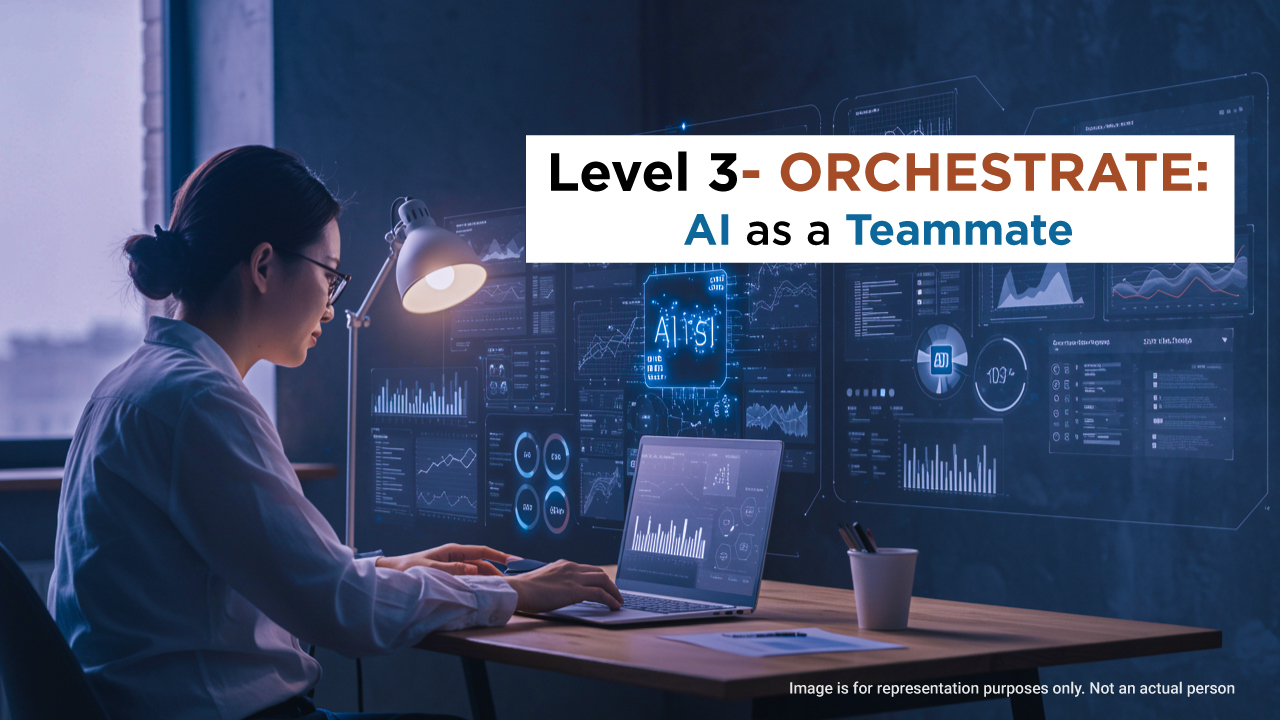
When AI Starts Contributing to Work, but Still Fails to Scale Across the Organization
By the time organizations reach this stage, something important has changed.
AI is no longer used occasionally. It is no longer just assisting with tasks. It has become part of how individuals approach their work. Employees interact with it regularly, refine outputs through iteration, and begin to rely on it for meaningful contributions.
This is Level 3.
At this stage, AI becomes a teammate. It participates in the workflow. It supports thinking, improves outputs, and helps individuals deliver higher-quality work.
For the first time, AI starts creating real value.
But this value remains limited.
What Level 3 Looks Like in Reality
Level 3 settings involve integrating AI into everyday work practices. Employees do not merely use it to complete isolated tasks. They apply it in the work life cycle.
Through AI, a consultant can organize a problem, hone analysis, and enhance recommendations. A product manager uses it to brainstorm features, simulate situations, and make documentation. A marketer uses it to repeat, test, and optimize campaigns.
AI is introduced into the thought process.
There is no longer linear work. It becomes iterative. Products are polished several times. Concepts are examined in greater depth. Quality improves.
It is an unmistakable shift in content.
However, this shift is still happening at an individual level.
The Rise of Individual Excellence
Level 3 develops high-performing individuals.
When employees know how to collaborate with AI, they start to perform better than others. They are sharper in their production. They think more systematically. They are more sophisticated and executed more quickly.
Such people successfully create their own AI-driven processes.
These workflows are individual.
They are not documented. They are not common. They do not conform to uniformity.
Consequently, the organization's performance is diverse. Some perform at a very high level while others are at lower levels of maturity.
This establishes a different form of fragmentation.
Not among the teams, but within them.
Why Value Still Does Not Scale
Although the quality of output is evidently improved, Level 3 organizations are unable to scale the impact.
This is because of a simple reason. There is no system.
There is the use of AI, which is not combined.
No common playbooks exist that outline the use of AI in various positions. No standard workflows exist for incorporating AI into delivery. There is no alignment on what good looks like.
The knowledge is still imprisoned in people.
High performers take their ways with them. When teams work together, they fail to work at the same capacity. New staff members have to learn afresh once they start working.
AI is an advantage to the organization; however, it cannot develop it.
The Hidden Ceiling of Level 3
Level 3 is a sense of improvement. And it is.
This is the first time AI is affecting the way work is performed. It is enhancing the reason, not only the action. It is not only increasing speed, but also quality.
But it brings on an invisible ceiling.
Organizations start relying on people to make AI successful. They rely on talent rather than constructing systems. Rather than establishing consistency, they accept change.
This limits scalability.
AI is a multiplier for people, but not for organizations.
To transcend this stage, the emphasis needs to shift once more.
Individuals to teams.
What Is Still Missing
Even at this stage, three key elements are absent:
Shared Playbooks: No common standards for how AI is used across roles and teams
Workflow Standardization: AI is not embedded into repeatable delivery processes
Organizational Alignment: Teams operate at different levels of maturity without coordination
Without these, AI cannot become a collective capability.
It remains powerful, but contained.
The Role of VMI Global
This is where the transition becomes critical, and where VMI Global plays a defining role.
At Level 3, the challenge is not capability. It is consistency.
VMI Global works with organizations to convert individual excellence into team-level systems. The first step is identifying where value already exists. Through real-world behavioral analysis, VMI Global maps how high-performing individuals use AI in their workflows.
These patterns are not left isolated.
They are codified.
VMI Global converts such practices into systematized playbooks that teams can embrace. This establishes a common benchmark of the application of AI in certain positions, job activities, and outputs. Quality is repeatable and not subject to individual ability.
The second stage is team-level workflow integration. AI is integrated into the collaboration, review, and delivery processes. Teams start working similarly, and AI is not just an auxiliary tool but an integral part of the work.
VMI Global also solves the fragmentation that curtails scale. We reduce AI adoption skew by aligning leadership expectations, team practices, and system design. Progress becomes collective.
The objective is clear. Move from isolated capability to shared performance.
What Comes Next
Level 3 proves that AI can improve work.
But improvement is not enough.
The next level is where AI stops being a personal advantage and becomes a team-wide system. It is where consistency replaces variation and workflows are redesigned to fully integrate AI.
That is where organizations begin to scale intelligence.
Key Insights
| Insight | Explanation |
|---|---|
| AI at this stage enhances thinking, not just execution | It supports iteration, problem structuring, and deeper analysis, improving the quality of outputs |
| Individual mastery creates uneven organizational performance | High performers build their own AI workflows, while others lag, leading to inconsistency within teams |
| Lack of shared systems prevents scalability of value | Without standardized playbooks and workflows, AI benefits remain isolated and cannot be replicated |
| Organizations become dependent on individuals instead of processes | Success relies on talent rather than structured systems, creating risk and limiting continuity |
| Transitioning to the next level requires systemization of AI usage | Converting individual practices into shared, repeatable workflows is essential for scaling impact |
Frequently Asked Questions (FAQs)
AI becomes part of the daily workflow, supporting thinking, iteration, and execution across tasks. It contributes to outputs rather than just assisting with isolated activities. This allows employees to produce higher-quality work more efficiently.
At Level 2, AI improves individual productivity, while at Level 3, it enhances how individuals think and deliver work. The interaction becomes more iterative and integrated into workflows. However, it still remains limited to individual use rather than team-wide systems.
Because AI usage is not standardized or shared across teams. High-performing individuals create their own workflows, but these are not documented or replicated. This prevents organizations from building consistent, repeatable systems.
They experience uneven performance across teams and dependence on individual expertise. Knowledge remains siloed, and collaboration lacks consistency. This creates fragmentation and limits long-term scalability.
They need to standardize AI usage through shared playbooks and integrate it into team workflows. Aligning leadership, processes, and tools is essential for scaling impact. This shift enables AI to move from individual advantage to organizational capability.