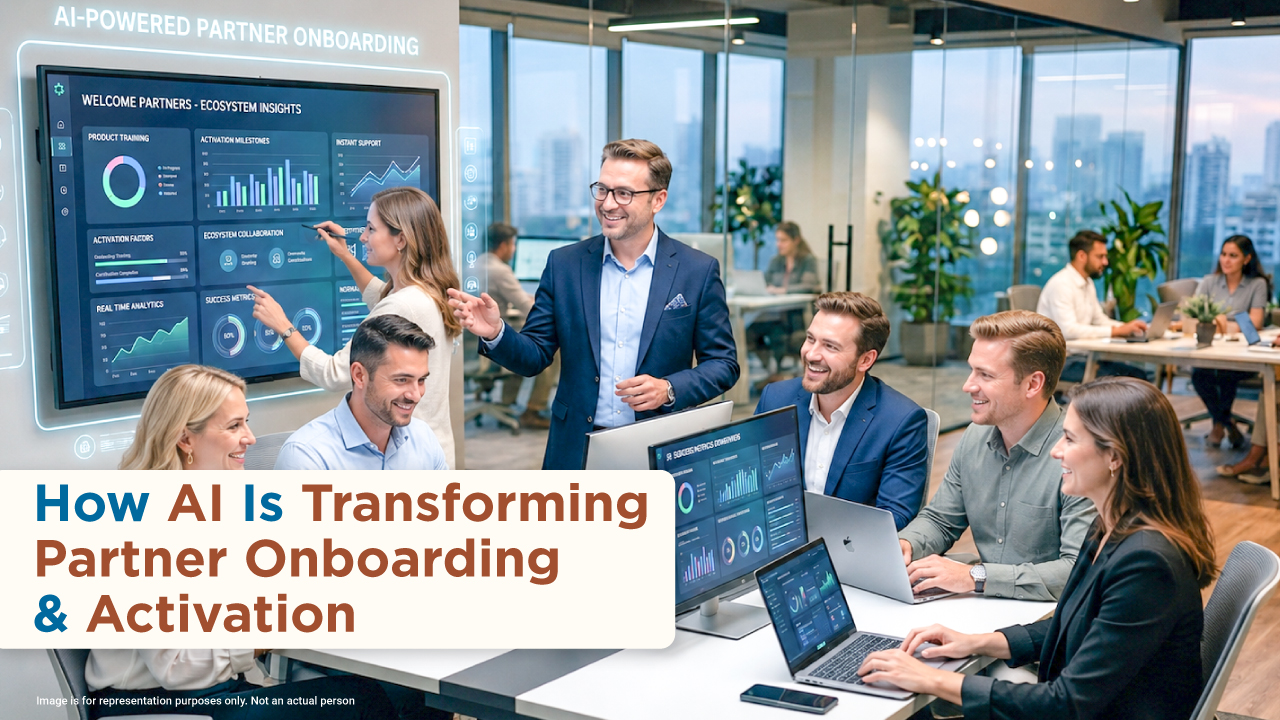
A new partner signed the agreement on a Friday.
The excitement was real. The opportunity looked promising. Revenue projections were optimistic. Internal teams celebrated another addition to the growing ecosystem.
Then came the onboarding process.
A welcome email was sent, training materials were shared, and multiple documents were attached. A portal login was created for uploading product decks. Meetings were scheduled, and follow-up reminders were sent.
Weeks passed.
The partner attended some sessions, skipped others, and struggled to find the right resources when needed. Questions were answered through email chains. Information lived across multiple systems. Progress became difficult to track. Momentum slowly faded.
By the time the partner was fully operational, months had passed.
This story is not unusual. It represents the reality of many channel ecosystems today.
For decades, partner onboarding was treated as an administrative process. Organizations focused on distributing information, delivering training, and completing compliance requirements. Success was measured by how much content was shared rather than how quickly partners became productive.
Today, that approach is becoming increasingly ineffective.
As businesses expand their partner networks across regions, industries, and markets, traditional onboarding methods struggle to keep pace with growing complexity and rising expectations.
The Growing Need for AI in Partner Enablement
Modern partners want to have more than just information.
They demand customization, timely assistance, easy access to materials, and straightforward routes to success.
Meanwhile, organizations are under growing pressure to make partners more active and to operate the ecosystem more effectively at lower operational cost.
That's where AI is making a difference.
AI is revolutionizing partner onboarding, making it more dynamic and adaptive to individual partner needs in real time.
Instead of overwhelming partners with lengthy documentation and standardized training programs, AI-powered systems can create customized onboarding journeys based on business models, market focus, experience levels, and growth objectives.
Several other onboarding paths may differ depending on whether a distributor is entering a new geographical area or a reseller with enterprise customers. AI enables the efficient delivery of these personalized experiences at scale.
The result is not simply improved onboarding.
The result is faster partner activation.
How AI Accelerates Partner Activation
A partner is activated when they start delivering measurable business value.
The faster one becomes active, the more robust the ecosystem becomes.
In the past, a prolonged time was needed to decrease this period. Channel managers invested many hours in preparing and training, in answering the same questions over and over again, and in tracking progress.
As ecosystems expanded, it became harder to maintain this level of support.
AI brings a new model.
Intelligent systems can give context-based advice throughout the onboarding process. Now, partners do not need to wait until a meeting or support ticket is scheduled to get help. Rather, they have access to tips, solutions, and resources when they need them.
This makes for a more dynamic and interactive experience.
Learning becomes personalized, support becomes immediate, and
Activation becomes faster.
The organizations are more efficient, and the partners are more confident sooner.
AI-Native Learning Creates Better Partner Experiences
A key strength of AI is its ability to tailor learning experiences to each individual.
There is a traditional structure to onboarding programs. The same content is being shared with all partners, irrespective of their objectives, knowledge, and market needs.
This often results in information overload and decreased engagement.
AI can transform this by determining what partners need to learn and when.
Rather than consuming a lot of content in one go, partners can get just what they need over time as they engage in activities, perform, and pursue business goals.
This helps to foster a better learning space.
Partners do less information searching and more knowledge application in real-world situations.
This means onboarding is an ongoing process rather than an end-to-end experience.
The Role of AI in Ecosystem Intelligence
A major challenge of partner onboarding has always been visibility.
It is difficult for many organizations to grasp which partners are on track to succeed and which need more assistance.
Issues may only become apparent when performance starts to drop off.
AI adds a new dimension to the ecosystem's intelligence.
Engagement patterns, training participation, resource utilization, communication activity, and workflow interactions are analyzed to understand partner behavior better.
This visibility helps teams recognize problems early.
Organizations can identify partners that are doing well, those that are challenged, and those that need intervention before performance is impacted.
This leads to data-driven and proactive ecosystem management.
Moving from Administrative Onboarding to Intelligent Enablement
Partner onboarding is not a technology replacement program.
It's about empowering people with intelligence.
The top-performing companies won't just automate the onboarding procedures they currently use. They will reshape the partner experience to enable continuous learning, adaptive support, and ecosystem-wide intelligence.
This change is from administrative enrolment to intelligent enablement.
The number of course completions and downloaded documents will no longer be used to define success.
Instead, meaningful readiness indicators will be used.
Do partners confidently position solutions?
Are they able to use resources easily and rapidly?
Are they able to communicate effectively with customers?
Are they able to survive on their own in the environment?
These behavioral outcomes offer a much more precise view of the partner's readiness than traditional completion measures.
The Future of AI-Driven Channel Ecosystems
Organizations require more than efficiency, as channel ecosystems become more complex.
They must have intelligent systems that can enable learning, collaboration, engagement, and growth at scale.
AI provides the foundation for this transformation.
It enables organizations to create personalized onboarding experiences, shorten the activation process, boost partner engagement, and build ecosystem intelligence to make better decisions.
Onboarding is not a one-and-done program; it's a long-term journey of partnership.
Those that accept AI-enabled enablement will be better equipped to establish strong, effective, and efficient partner ecosystems.
How VMI Global Helps Organizations Build Channel Readiness
At VMI Global, we believe the future of channel success depends on ecosystem readiness rather than ecosystem size. Through the ALLIANCE Channel Readiness Framework, we help organizations assess their partner networks' readiness for AI-native enablement, intelligent collaboration, and scalable ecosystem growth.
Our approach goes beyond onboarding programs and technology adoption. We evaluate the behaviors, workflows, learning systems, and operational capabilities that determine how effectively partners can contribute within a modern ecosystem. By measuring readiness across onboarding, enablement, ecosystem intelligence, and AI integration, organizations gain a clear understanding of where they stand and what needs to evolve.
As channel ecosystems enter a new era of intelligent operations, readiness will become one of the strongest predictors of long-term success. VMI Global helps organizations build the capabilities, structures, and strategies required to create future-ready partner networks that can adapt, scale, and thrive in the AI-native age.