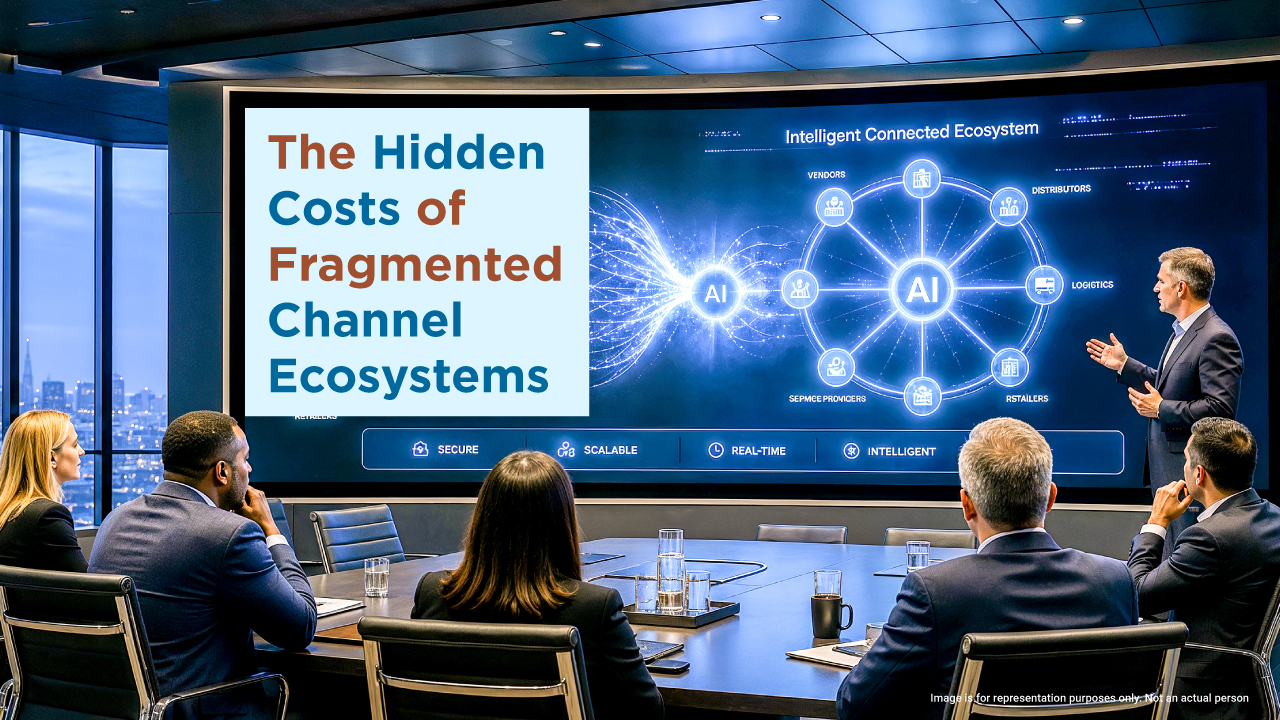
A company had spent years expanding its channel ecosystem.
New distributors were added across multiple regions. Resellers were recruited to enter new markets. Service partners were trained to support customers. Enablement programs were launched. Partner portals were introduced. Communication channels multiplied.
From the outside, everything looked impressive.
The ecosystem was growing.
The partner count was increasing.
The market presence was expanding.
Yet something felt wrong.
Growth was slower than expected.
Partner engagement was inconsistent.
Enablement efforts produced mixed results.
Customer experiences vary from one region to another.
Internal teams struggled to understand where the problems existed.
The organization had built a large ecosystem.
What it had not built was a connected ecosystem.
And that distinction matters more than ever.
As channel networks grow, fragmentation often becomes one of the most expensive and least visible barriers to sustainable growth.
What Is a Fragmented Channel Ecosystem?
Fragmentation occurs when different parts of the ecosystem operate independently rather than collaboratively.
Partners use different systems.
Teams follow different processes.
Information exists in multiple locations.
Communication flows through disconnected channels.
Learning experiences vary across regions.
Support structures operate in silos.
None of these issues may appear significant individually.
Together, however, they create an ecosystem that becomes increasingly difficult to manage, scale, and optimize.
The challenge is that fragmentation rarely announces itself.
It does not appear as a single failure.
Instead, it quietly reduces efficiency, slows decision-making, weakens collaboration, and limits growth.
Many organizations do not recognize the true cost until performance begins to suffer.
The Cost of Slower Partner Activation
One of the first impacts of fragmentation is delayed partner activation.
When onboarding systems, training resources, certifications, support channels, and operational workflows are disconnected, partners take longer to become productive.
Information becomes harder to access.
Learning becomes inconsistent.
Questions take longer to resolve.
Partners spend valuable time navigating processes instead of engaging customers.
The result is a longer journey from recruitment to revenue generation.
In competitive markets, those delays can become costly.
Organizations often focus on acquiring new partners while overlooking how fragmented ecosystems prevent existing partners from reaching their full potential.
How Fragmentation Reduces Partner Engagement
Partner engagement depends on clarity, accessibility, and confidence.
Partners want to know where to find information.
They want access to relevant resources.
They want support when challenges arise.
Fragmented ecosystems make it difficult to meet these simple expectations.
Partners may receive conflicting information from different teams.
Resources may exist across multiple platforms.
Updates may reach some partners while others remain uninformed.
Over time, engagement begins to decline.
Partners become less active.
Training participation decreases.
Collaboration weakens.
The ecosystem slowly loses momentum.
Many organizations interpret declining engagement as a partner performance issue.
In reality, it is often an ecosystem design issue.
The Hidden Impact on Customer Experience
Fragmentation not only affects partners.
It ultimately affects customers.
When partners operate with inconsistent information, varying levels of training, and disconnected support systems, customer experiences become unpredictable.
Some customers receive exceptional service.
Others receive outdated information.
Some implementations proceed smoothly.
Others encounter avoidable delays.
The inconsistency creates risk.
Customers rarely distinguish between the organization and its partners.
They view the ecosystem as a single experience.
When fragmentation affects partner performance, it also affects customer trust.
As ecosystems become larger, upholding consistency becomes increasingly important.
Why Communication Gaps Become Growth Barriers
Communication is often one of the first areas where fragmentation becomes visible.
As ecosystems expand, information must travel across multiple regions, teams, distributors, and partner groups.
Without connected systems, important updates can become delayed, diluted, or overlooked entirely.
Product announcements may not reach every partner.
New enablement resources may remain underutilized.
Strategic priorities may be interpreted differently across regions.
The result is misalignment.
And misalignment creates friction.
Organizations invest heavily in creating resources, content, and programs.
Their effectiveness depends on whether the right people receive the right information at the right time.
Fragmented communication systems make this increasingly difficult.
The Operational Costs Organizations Often Overlook
Fragmentation creates financial costs that are rarely visible on balance sheets.
Teams spend more time answering repetitive questions.
Support requests increase.
Duplicate resources are created.
Manual coordination becomes necessary.
Reporting requires additional effort.
Meetings multiply to compensate for a lack of visibility.
The organization gradually invests more resources to maintain ecosystem operations.
Growth becomes more expensive.
Efficiency declines.
Scalability becomes harder to achieve.
These operational costs often accumulate over years before organizations fully recognize their impact.
Why AI-Native Ecosystems Will Be More Connected
The future of channel growth depends on reducing fragmentation rather than managing it.
Artificial intelligence is helping organizations move toward more connected ecosystems.
AI can improve access to knowledge, simplify support experiences, identify communication gaps, and provide ecosystem-wide visibility.
Instead of relying on disconnected systems, organizations can create integrated environments where information flows more effectively.
Partners gain faster access to resources.
Support becomes more responsive.
Learning becomes more personalized.
Collaboration becomes easier.
The ecosystem begins operating as a connected network rather than a collection of isolated participants.
This transition will become increasingly important as partner ecosystems continue to grow in complexity.
From Fragmentation to Ecosystem Intelligence
The organizations that succeed in the coming decade will not simply build larger partner networks.
They will build more connected ones.
They will prioritize ecosystem intelligence over ecosystem size.
They will focus on visibility rather than assumptions.
They will create systems that enable collaboration rather than reinforce silos.
Most importantly, they will recognize that ecosystem performance depends on how effectively people, processes, knowledge, and technology work together.
The future belongs to ecosystems that can learn, communicate, and adapt as a unified network.
How VMI Global Helps Organizations Build Connected Channel Ecosystems
At VMI Global, we believe that fragmentation is one of the greatest hidden barriers to ecosystem growth. Through our ALLIANCE Channel Readiness Framework, we help organizations assess the structures, systems, and behaviors that influence ecosystem performance.
Our approach evaluates partner onboarding, enablement effectiveness, communication maturity, workflow integration, ecosystem intelligence, collaboration readiness, and AI adoption capabilities. By identifying areas of fragmentation, organizations gain a clearer understanding of the obstacles limiting partner productivity and ecosystem growth.
As channel ecosystems become increasingly complex, success will depend on an organization's ability to create connected experiences across every stage of the partner journey. VMI Global helps organizations build AI-native ecosystems that reduce friction, improve collaboration, enhance visibility, and lay the foundation for scalable, sustainable growth.